We have new points on the map of active protection of the Lesser Horseshoe Bat in the country!
A further 10 bat huts were built in the Dukla Forest District in the Beskid Niski Mts. These include three huts financed with the support of the PGE Foundation as part of the ‘Forest huts for bats’ project. They are part of our LIFE+ Horseshoe Bat Towers project – a task carried out in cooperation with the State Forests.
The huts have interesting names. They are the Peloid Hut, the Bizarre Hut and the Hut on the Downs. Two of them are located in the tourist and walking spa forests, while Hut on the Downs stands by the popular hiking trail to Cergowa Mountain. Why this exactly placements?
The choice of locations for the huts is never random. Firstly, they are places of high bat activity, which we identified during the summer nights. Secondly, such a location will allow us to reach a large audience with information about bat conservation measures. Such locations have the potential for conducting observations and educational activities at them.
The Bizarre Cottage is a hut on Przedziwna Mountain on the western side of spa town Iwonicz-Zdrój. During the day it is an attractive walking area, but evening and night belong here to the bats! Especially to the Lesser horseshoe bat, whose breeding colony we have discovered during recent surveys in the nearby mineral water fountain room. Hut on teh Downs is located at the foot of the Cergowa Mountain massif. This mountain is embraced by the Natura 2000 area Ostoja Jaśliska, and its northern slopes are also protected as a reserve. The slopes of Cergowa are known to contain numerous caves – hibernacula for many bat species, including the lesser horseshoe. Peloid Hut is located on Borowinowa Mountain, east of Iwonicz-Zdrój. Right next to the hut runs the border of the Rymanów Natura 2000 area, of which the Lesser horseshoe bat is one of the target species.
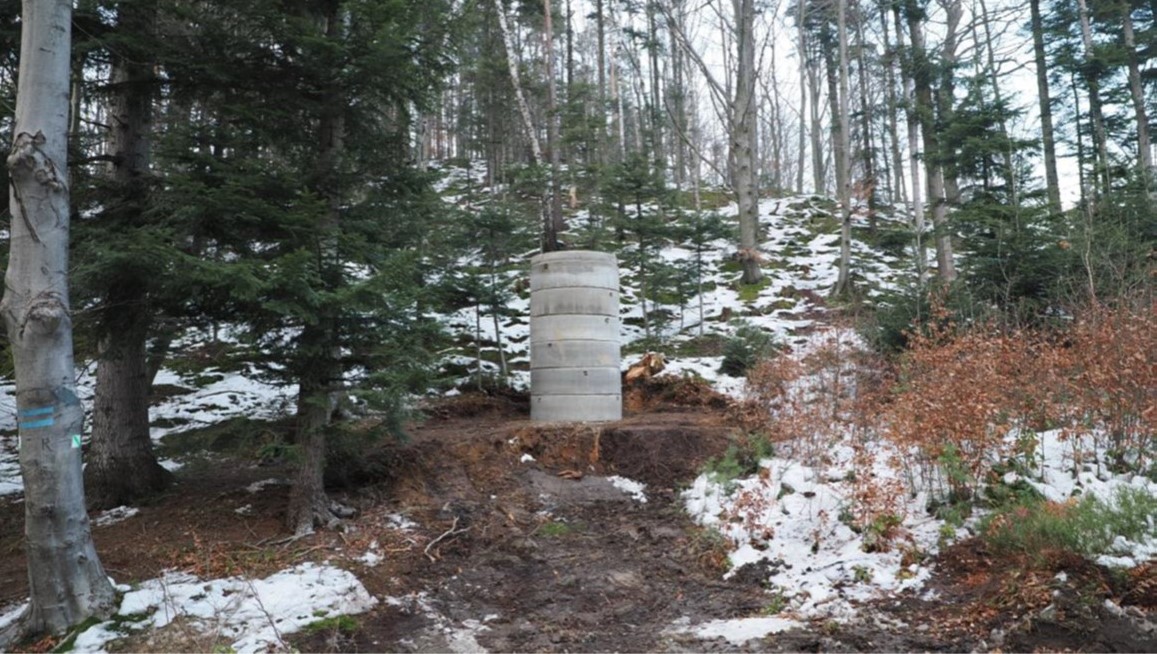
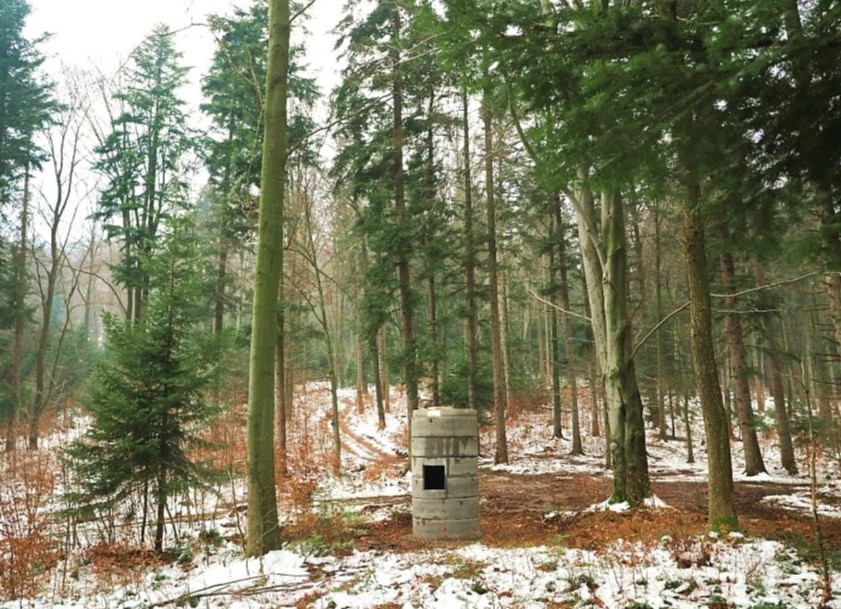
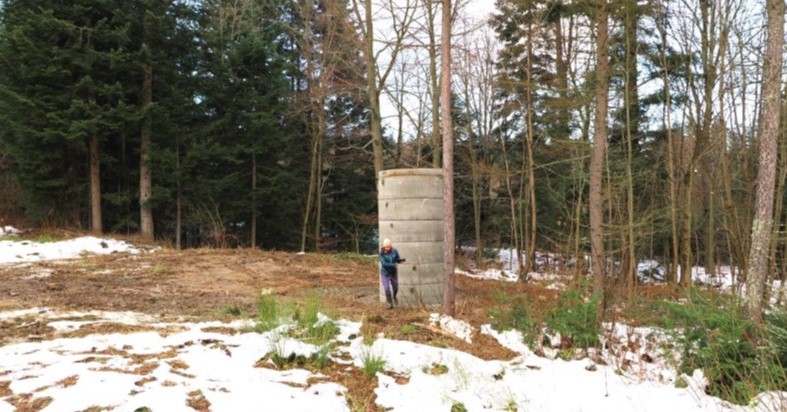
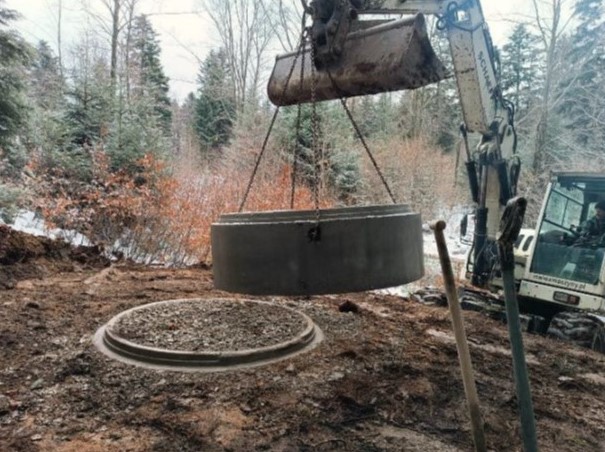
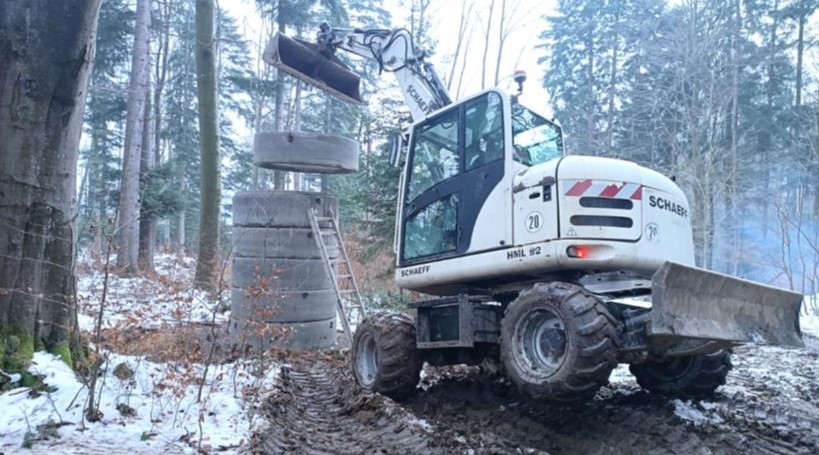
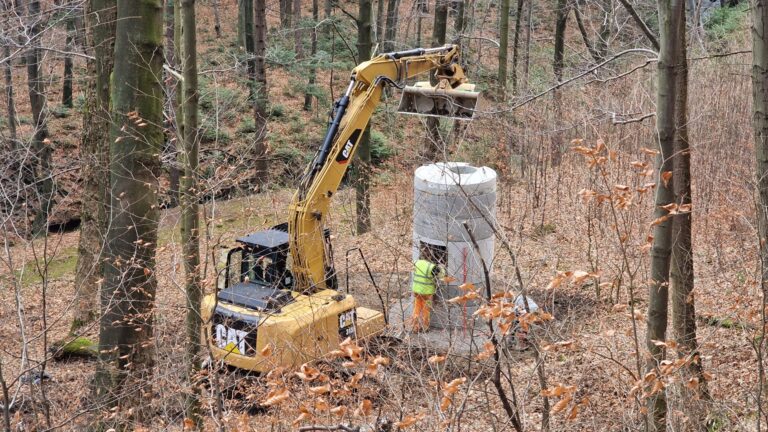
How are the huts built? During construction, the use of heavy equipment is necessary due to the high weight of the elements. In the first stage, the huts are built as a stable structure embedded in the ground and sealed from the top with a concrete slab. They are composed of concrete rings with an inner diameter of 1.5 metres. A structure prepared in this way could already successfully serve as a night shelter for horseshoes. This is where similar huts are being completed in the UK. In the LIFE+ Podkowiec Towers project, however, we have gone one step further: we have decided to encase the concrete in wood and fit the top of the structure with a roof, under which a small attic space has been retained. All this is done in order to exploit the full potential of the new shelters and increase the chances of them being used by other bat species. Such enhancements improve the microclimatic conditions inside the building, and no doubt they also have a positive effect on the aesthetics of the shelter. The latter is particularly important given the public acceptance of new infrastructure in woodland areas.
What role do the huts play and where are they built? We build the huts in the areas called the Land of the Horseshoe Bat, i.e. in the mountainous and upland regions of southern Poland. These are special nocturnal shelters where horseshoes can rest during breaks in foraging. Their availability reduces the impact of hazards associated with commuting flights of bats during the night. They can also provide daytime roosts, especially during transitional periods, as well as mating shelters.
The PGE Foundation has supported activities whose main objective is to strengthen the populations of rare bat species considered endangered in Europe, including in particular the Lesser horseshoe bat, the Geoffroy’s bat and Barbastelle. The Dukla Forest District is the next one, after the Bardo and Zdroje Forest Districts in Lower Silesia, in which this type of bat shelters has been built. We know from experience that we will not have to wait long for the effects of these actions!
Our gallery shows the stage of construction of the huts before they were encased in wood and roofs were built. Wooden cladding will start in spring!